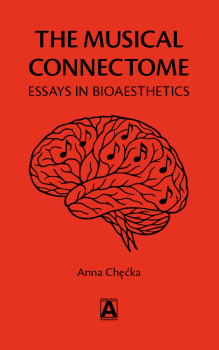
The Musical Connectome. Essays in Bioaesthetics
Słowa kluczowe:
bioestetyka, filozofia, filozofia muzyki, mózg, muzyka, neurobiologia, ChopinStreszczenie
Anna Chęćka’s book will prove an inspiring work for musicians and philosophers alike. It encourages the reader not only to venture beyond the boundaries of their own specialization, but also to seek a thoughtful dialogue between different realms of human experience. I wholeheartedly recommend it as a work that, while offering substantial academic value, is also written with artistic flair and a finely tuned sense of language, qualities that grant the reader not only intellectual benefit but genuine pleasure.
(From a review by Prof. Katarzyna Popowa-Zydroń, chair of the jury of the International Chopin Competition)
Bibliografia
Allison, J., & Chęćka, A. (2021, October 20). Critics’ talk: An examination of conscience. Chopin Courrier, 17.
Ammar, A., & Bernstein, M. (Eds). (2020). Neurosurgical ethics in practice: Value based medicine. Cambridge University Press.
Bauby, J.-D. (1998). The diving bell and the butterfly: A memoir of life in death (J. Leggatt, Trans.). Vintage.
Berger, K. (2000). A theory of art. Oxford University Press.
Blood, A. J., & Zatorre, R. J. (2001). Intensely pleasurable responses to music correlate with activity in brain regions implicated in reward and emotion. Proceedings of the National Academy of Sciences, 98(20), 11818–11823. https://doi.org/10.1073/pnas.191355898
Bowie, A. (2014). Music, philosophy, and modernity. Cambridge University Press.
Cabeza, R., Kingstone, A., & Owens, B. P. (Eds). (2006). Handbook of functional neuroimaging of cognition (2nd ed.). MIT Press.
Chatterjee, A. (2014). The aesthetic brain: How we evolved to desire beauty and enjoy art. Oxford University Press.
Chatterjee, A., & Cardillo, E. R. (Eds). (2022). Brain, beauty, & art: Essays bringing neuroaesthetics into focus. Oxford University Press.
Chęćka, A. (2021). Metaphysical hearing (J. Comber, Trans.). National Institute of Fryderyk Chopin.
Chyrowicz, B. (2020). Mózg z moralnego punktu widzenia. Postulat neurobiologicznej rekalibracji etyki [The Brain from a Moral Perspective: A Postulate for the Neurobiological Recalibration of Ethics], Diametros, 17(63), 1–33. https://doi.org/10.33392/diam.1249
Cope, Z., Minassian, A. et al. (2017). Modafinil improves attentional performance in healthy, non-sleep deprived humans at doses not inducing hyperarousal across species. Neuropharmacology, 125. https://doi.org/ 10.1016/j.neuropharm.2017.07.031
Cortot, A. (2013). In search of Chopin (C. & R. Clarke, Trans.). Dover Publications.
Curley, E. (1988). Behind the Geometrical Method: A Reading of Spinoza’s Ethics. Princeton University Press.
Damasio, A. (2006). Descartes’ error: Emotion, reason, and the human brain. Vintage.
Das Manifest (n.d.). Was wissen und können Hirnforscher heute? Spektrum.de. https://www.spektrum.de/thema/das-manifest/852357
Davies, J. Q. (2014). Romantic Anatomies of Performance. University of California Press.
Davies, S. (2002). Profundity in instrumental music. The British Journal of Aesthetics, 42(4), 343–356. https://doi.org/10.1093/bjaesthetics/42.4.343
Dorobantu, M., Geraci, R. et al. (2024). Religious robots: AI as religious subject and object – Special guest-edited section. Zygon: Journal of Religion & Science, 59, 661–787. https://doi.org/10.1111/zygo.12979
Duffau, H. (2016). L’erreur de Broca: Exploration d’un cerveau éveillé. Éditions Odile Jacob.
Dutton, D. (2009). The art instinct: Beauty, pleasure, and human evolution. Oxford University Press.
Gavoty, B. (1995). Alfred Cortot: Biographie. Buchet-Chastel.
Glover, P. (2010). Understanding neuroimaging. Routledge.
Gould, S. J. (2003). The hedgehog, the fox, and the magister’s pox: Mending the gap between science and the humanities. Harmony Books.
Grau, D., & Zahm, O. (2020). Philosophy with Catherine Malabou. Purple Magazine, The Brain Issue, 33. https://purple.fr/magazine/the-brain-issue-33/philosophy-with-catherine-malabou
Johnson, J. (2020). After Debussy: Music, language, and the margins of philosophy. Oxford University Press.
Joyce, K. A. (2008). Magnetic appeal: MRI and the myth of transparency. Cornell University Press.
Kimura, T. (2018). Masahiro Mori’s Buddhist philosophy of robot. Paladyn, Journal of Behavioral Robotics, 9, 72–81. https://doi.org/10.1515/pjbr-2018-0004
Kivy, P. (1990). Music alone: Philosophical reflections on the purely musical experience. Cornell University Press.
Kivy, P. (2001). Music, memory and “music in the moment”. In New essays on musical understanding (pp. 183–217). Oxford University Press.
Kivy, P. (2009). Antithetical arts: On the ancient quarrel between literature and music. Oxford University Press.
La Rocca, M. C. (2016). L’écriture des émotions: Approches cognitives et littéraires. L’Harmattan.
Larsen, S. N. (2013). The plasticity of the brain – An analysis of the contemporary taste for and limits to neuroplasticity. In P. Larrieu, B. Roullet, & C. Gavaghhan (Eds), Neurolex sed… dura lex? L’impact des neurosciences sur les disciplines juridiques et les autres sciences humaines: Études comparées (pp. 33–59). City Print.
Levinson, J. (1990). Music and negative emotion. In Music, art, and metaphysics: Essays in philosophical aesthetics (pp. 295–314). Cornell University Press.
Lorenc, I. (2005). Filozoficzny charakter współczesnej estetyki [The philosophical character of contemporary aesthetics]. Diametros, 3, 86–94.
Luck, S. J. (2014). An introduction to the event-related potential technique (2nd ed.). MIT Press.
Lucy the Pianist (2025). Lucy the Pianist. https://www.lucythepianist.com
Malabou, C. (2008). What should we do with our brain? (S. Rand, Trans.). Fordham University Press.
Malabou, C. (2012). Ontology of the accident: An essay on destructive plasticity (C. Shread, Trans.). Polity Press.
Mann, T. (1994). Buddenbrooks: The decline of a family (J. E. Woods, Trans.). Vintage Books.
Mann, T. (1995). The magic mountain (H. T. Lowe-Porter, Trans.). Vintage International.
Matuszyński, J. (1837). De l’influence du nerf sympatique sur les fonctions de sens. Faculté de Médecine.
Menninghaus, W., Wagner, V., Wassiliwizky, E., Schindler, I., Hanich, J., Jacobsen, T., & Koelsch, S. (2019). What are aesthetic emotions? Psychological Review, 126(2), 171–195. https://doi.org/10.1037/rev000013
Monsaingeon, B. (n.d.). Leonard Bernstein recalls the death of Nadia Boulanger [Video]. Bruno Monsaingeon. https://www.brunomonsaingeon.com/EN/PERFORMERS/BOULANGER.html
National Institutes of Health (2009). The Human Connectome Project. https://www.humanconnectome.org
Neve, C. (2023). Immortal thoughts: Late style in a time of plague. Thames & Hudson.
Nexus Institute (2010, June 11). George Steiner: What’s next for the West? Superman meets Beethoven [Video]. YouTube. https://www.youtube.com/watch?v=oKh7edvRvFQ
Patston, T., & Loughlan, T. (2014). Playing with performance: The use and abuse of beta-blockers in the performing arts. Victorian Journal of Music Education, (1), 3–10.
Plato (1929). Timaeus (R. G. Bury, Trans.). Harvard University Press.
Pociej, B. (2005). Z perspektywy muzyki [From the perspective of music]. Więź.
Proust, M. (2002). Finding time again. In In search of lost time (I. Patterson, Trans.). Allen Lane, Penguin Press.
Przybylski, R. (2011). A swallow’s shadow: An essay on Chopin’s thoughts (J. Comber, Trans.). Fryderyk Chopin Institute.
Przybysz, P. (2020a). Czy należy bać się neuroestetycznego redukcjonizmu? Przypadek emocji muzycznych [Should we be afraid of neuroaesthetic reductionism? The case of musical emotions]. Sztuka i Filozofia, 56, 23–41.
Przybysz, P. (2020b). What are aesthetic emotions? Interdisciplinary Studies in Musicology, 20, 57–58.
Przybysz, P. (2023). Neuroestetyka 2.0: O wewnętrznej ewolucji naturalistycznego programu badań nad sztuką [Neuroaesthetics 2.0: On the internal evolution of the naturalistic research program on art]. Sensus Historiae, LIII(3–4), 143–164.
Quignard, P. (2016). The hatred of music (M. Amos & F. Rönnbäck, Trans.). Yale University Press.
Rosenfeld, A. (2024, January 23). Were they heroes or Collaborators? Forward.com. https://forward.com/culture/193898/were-they-heroes-or-were-they-collaborators
Salimpoor, V. N., Benovoy, M., Larcher, K., Dagher, A., & Zatorre, R. J. (2011). Anatomically distinct dopamine release during anticipation and experience of peak emotion to music. Nature Neuroscience, 14(2), 257–262. https://doi.org/10.1038/nn.2726
Sève, B. (2002). L’altération musicale: ou ce que la musique apprend au philosophe, coll. Poétique, Éditions du Seuil.
Sève, B. (2013). L’instrument de musique: Une étude philosophique. Éditions du Seuil.
Sève, B. (2023). Les matériaux de l’art. Éditions du Seuil.
Spinoza (2000). Ethics (G. H. R. Parkinson, Trans.). Oxford University Press.
Spitzer, M. (2021). The musical human: A history of life on Earth. Bloomsbury Publishing.
Sporns, O. (2012). Discovering the human connectome. MIT Press.
Steiner, G. (1989). Real presences: Is there anything in what we say? Faber & Faber.
Steiner, G. (2001). Grammars of creation. Faber & Faber.
Steiner, G. (2011). The Poetry of Thought: From Hellenism to Celan. New Directions Book.
Strathausen, C. (2017). Bioaesthetics: Making sense of life in science and the arts. University of Minnesota Press.
Wilczek, F. (2015). A beautiful question: Finding nature’s deepest design. Allen Lane.
Wilson, E. O. (1998). Consilience: The unity of knowledge. Vintage Books.
Zatorre, R. J. (2024). From perception to pleasure: The neuroscience of music and why we love it. Oxford University Press.
Opublikowane
10 grudnia 2025
Kategorie
Prawa autorskie (c) 2025 Wydawnictwo Academicon
Licencja

Utwór dostępny jest na licencji Creative Commons Uznanie autorstwa – Na tych samych warunkach 4.0 Miedzynarodowe.
Szczegóły dotyczące dostępnego formatu publikacji: Książka drukowana (oprawa twarda)
Książka drukowana (oprawa twarda)
ISBN-13 (15)
978-83-67833-26-4
Data pierwszego wydania (11)
2025-12-12
Szczegóły dotyczące dostępnego formatu publikacji: Książka drukowana (oprawa miękka)
Książka drukowana (oprawa miękka)
ISBN-13 (15)
978-83-67833-26-4
Data pierwszego wydania (11)
2025-12-12
Szczegóły dotyczące dostępnego formatu publikacji: E-book [PDF]
E-book [PDF]
ISBN-13 (15)
978-83-67833-47-9
Data publikacji (01)
2025-12-14